Reach Overhead Again Without Bracing for It
Move Better. Feel Better. Live Better.
The careful half-reach for the top shelf. The jacket you always put on your "bad" arm first. The 2am roll onto your good side because the other one won't let you sleep. If your shoulder has quietly started editing your day, you don't need another band exercise from a five-second reel — you need a plan built around how your shoulder actually works.

Guarding Your Shoulder? Afraid to Reach, Lift, or Sleep on It?
Shoulder pain is common: across 61 studies worldwide, the median prevalence in the community is about 1 in 6 adults.[1] It's also stubborn. Nearly half of people who see their doctor for a new bout of shoulder pain still have symptoms six months later.[2] You're told to rest it, ice it, or "stop doing that," so you stop reaching. The shoulder you were protecting gets stiffer and weaker, and your world gets a little smaller.
The Overhead Reach You've Stopped Making
Top shelves, overhead bins, hanging a picture, a pickleball serve. When reaching up pinches, you learn to hike your shoulder, lean, or ask someone else. The workaround feels safer, but it teaches the joint to do less every week.
A Stiff Upper Back Stealing Your Shoulder's Room
Your shoulder blade rides on your ribcage. When your upper back stays rounded (at a desk, in the car, on the couch), the blade can't tilt and rotate the way it should, and your arm runs out of space before it runs out of reach.
"Wait and See" That Turns Into Months
Resting a sore shoulder feels sensible. But in one primary-care cohort, 46% of patients still had symptoms six months after their first visit.[2] Rest calms things down. It doesn't rebuild the strength and control that keep the shoulder working.
I've just stopped reaching for anything above my head.
Common. And Very Responsive to the Right Exercise.
In that same rotator cuff study, people's own ratings of their shoulder improved significantly within 6 to 12 weeks of starting their exercise program.[5] Shoulders respond when you give them the right work.
Your Shoulder Is Built to Move. Its Base Is Built to Hold Steady.
Your shoulder is the most mobile joint in your body: a ball sitting on a shallow socket, like a golf ball on a tee. That freedom only works when the tee holds still and the muscles around the ball keep it centered.
A scan often isn't the whole story. In one village-wide screening, two-thirds of the rotator cuff tears found caused no symptoms at all.[3] And in a major UK trial, a common surgery for shoulder impingement pain did no better than a placebo "look-only" procedure.[4] For most everyday shoulder pain, the answer is in how the whole system moves: upper back, shoulder blade, and shoulder working together.
The Shoulder Joint (Glenohumeral)
A ball-and-socket built for mobility: reaching up, out, across, and behind you. It needs freedom in every direction, not just one.
The Rotator Cuff
Four small muscles that keep the ball centered in the socket as your arm moves. When they're weak or quiet, the bigger muscles take over and the ball drifts.
The Shoulder Blade (Scapulothoracic)
The "tee." Your shoulder blade glides on your ribcage to give your arm a stable, well-positioned base. Poor control here shows up as pinching and neck tension.
The Thoracic Spine
Your upper back is built to extend and rotate. When it moves freely, your shoulder blade can tilt back and your arm finds room to reach overhead.
Here's What Changes First

Go at your own pace • Designed by a Physical Therapist

Created by a Physical Therapist With 26 Years in the Field
"Your body is capable of far more than you think — it just needs the right kind of guidance."
Hi, I'm David. For the past 26 years I've helped thousands of people overcome stiffness, pain, and fear around movement — from athletes chasing peak performance to everyday people who just want to feel good in their bodies again. My background as a Physical Therapist, Strength and Conditioning Specialist, and certified movement expert (FMS, SFMA, TPI) has taught me one thing above all: most everyday shoulder pain comes from a stiff upper back, weak stabilizers, and guarded movement, not from something that's permanently broken.
You don't need extreme workouts, fancy equipment, or to already be "flexible." You just need a simple, step-by-step plan you can trust.
Specific. Guided. At home. No guesswork.
David Hawkins, PT, CSCS
Founder, Movement Answers
What Shoulder Pain Often Sounds Like
"I'd moved everything I use down to the bottom two shelves of the cupboard. Last week I put the coffee mugs back where they belong. Small thing, but I noticed it."
— Carol, 62
"I hadn't slept on my right side in over a year. I didn't even realize how much I'd rearranged my nights around it until I stopped having to."
— Jim, 57
"My serve had turned into a lob because reaching up hurt. I thought it was my shoulder joint. A lot of it was my upper back. Now I can actually get my arm up there."
— Linda, 49
"Putting my carry-on in the overhead bin used to be a two-step negotiation with my arm. On my last trip I just did it and sat down."
— Greg, 64
"Reaching behind my back to tuck in a shirt was the thing I dreaded every morning. It's the first thing that got easier, around the second week."
— Ann, 55
"My grandson wants to be lifted up to touch the ceiling every time he visits. For a while I said no. Now I'm the one who offers."
— Frank, 66
Composite examples reflecting patterns David has seen across thousands of patients over 26 years in practice — not verbatim quotes from named individuals to respect patient privacy.
21 Day Shoulder Pain Answers: Your 3-Week Path to a Freer, Stronger Shoulder
Every session works all three layers together: thoracic mobility, shoulder mobility, and shoulder-blade and rotator cuff stability. The seven-day rotation repeats each week, so you learn the movements in Week 1, own them in Week 2, and put them to work in Week 3.
Calm the Guarding, Open Up the Upper Back

Open books, cat-camel, elbow circles, and gentle shoulder-blade protraction and retraction ease protective bracing and give your upper back and shoulder room to move, while you learn exactly what's driving the pain.
- Understand your shoulder instead of fearing it
- Reduce stiffness and the urge to "protect" the arm
- Wake up the shoulder-blade muscles safely
Build Control Where It Counts

With the same rotation now familiar, you add control and consistency: wall slides, scapular push-ups, rotator cuff isometrics, and prone T, W, and A lifts that teach the ball to stay centered as the arm moves.
- Less end-of-day ache in the shoulder and neck
- A shoulder blade that holds steady under load
- More confidence lifting, carrying, and pushing
Reach Overhead & Return to Life

Full-range work like arm sweeps, the teacup drill, plank shoulder taps, and deep-squat overhead reaches puts everything together for real life: shelves, sports, sleep, and the grandkids.
- Confident overhead and behind-the-back reaches
- Smoother movement through daily tasks and hobbies
- A clear plan for keeping your shoulder feeling this way
15–20 minutes a day • Physical-therapist guided
Here's Everything You Get Inside 21 Day Shoulder Pain Answers
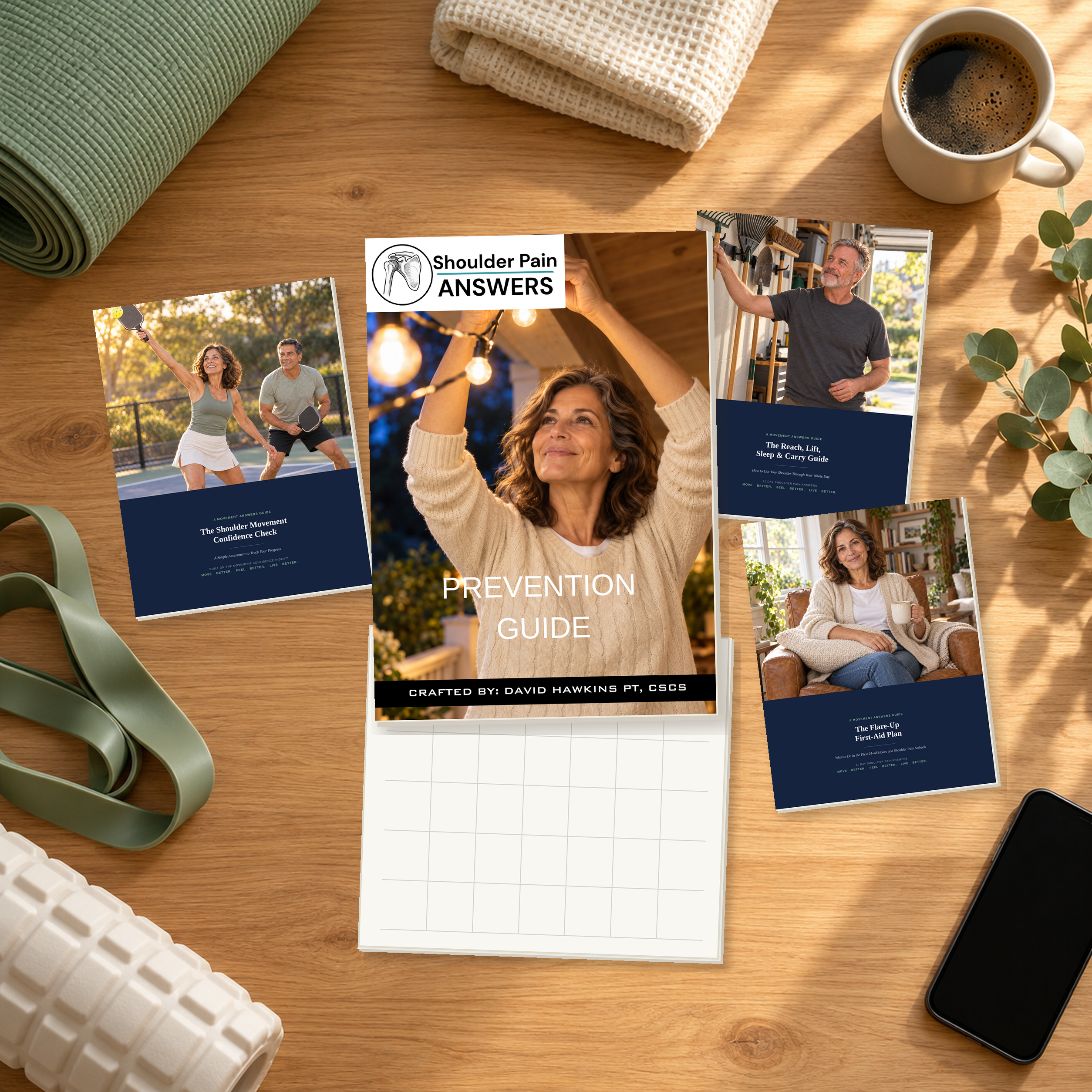
21 Follow-Along Video Sessions (15–20 min each)
Daily shoulder-specific routines covering thoracic mobility, shoulder mobility, and rotator cuff stability, every single day.
The Shoulder Pain Answers Guide + 21-Day Calendar
The anatomy and reasoning behind every exercise, plus a day-by-day calendar so you always know what's next.
Daily Encouragement & Reminder Emails
21 days of short, steady nudges that help you stay consistent.
Private Member Community
A low-pressure space to ask questions, share progress, and stay accountable.
Mobile Platform Access
Follow along from your phone, tablet, or computer — wherever you are.
The Flare-Up First-Aid Plan
What to do in the first 24–48 hours of a shoulder flare-up. Instant-download PDF.
The Reach, Lift, Sleep & Carry Guide
How to use your shoulder through your whole day: sleep positions, reaching high shelves, carrying bags, and desk setup.
The Shoulder Movement Confidence Check
A simple Day 1 and Day 21 self-assessment based on the Movement Confidence Index™.
Lifetime Access
Come back and reset anytime your shoulder needs it.
You save $569 — a one-time payment, yours for life
Start Your 21 Days — Get Instant Access

One-time payment. Instant access. Yours for life.
Start Your 21 Days — Get Instant AccessBacked by a 30-day money-back guarantee
What Makes This Different
Built specifically around the shoulder complex. This isn't a general mobility program with a few arm circles bolted on at the end.
Every session trains all three layers: upper back, shoulder joint, and the stabilizers that keep it centered. Most shoulder routines only work one.
David Hawkins has been doing this for 26 years as a licensed PT, not as an influencer with a resistance band and a theory.
The goal isn't checklist compliance. It's a shoulder you stop thinking about.
And when a flare-up hits on a random Tuesday (because eventually it will), there's a specific plan for that, not just "ice it and wait."


Is This the Right Next Step for You?
Right for you if you…
- Deal with recurring shoulder stiffness, pinching, or ache when reaching, lifting, or sleeping
- Catch yourself avoiding overhead reaches, behind-the-back movements, or sleeping on one side
- Have tried generic band exercises or rest without lasting change
- Want to understand your shoulder, not just be told what to do
- Can commit 15–20 minutes a day for three weeks
Not for you if you…
- Recently fell or injured the shoulder and can't lift your arm, or have numbness, tingling, or sudden weakness — see a physician first
- Have shoulder or arm pain with chest pressure, shortness of breath, or fever — seek medical care right away
- Are recovering from shoulder surgery and haven't been cleared by your surgeon or PT
- Are looking for a high-intensity strength program or a quick fix rather than a structured plan
Instant access • One-time purchase • Keep it for life
Try It Risk-Free
100% Money-Back Guarantee
21 Day Shoulder Pain Answers comes with a 30-Day Satisfaction Guarantee. If you're not completely satisfied with the program, contact us within 30 days for a full refund — no questions asked.
Frequently Asked Questions
Do I need any equipment?
Very little: a mat, a chair, a wall, and a pillow cover most sessions. A foam roller helps on a few upper-back days, and a rolled towel works if you don't have one.
I've been told I have a rotator cuff tear, impingement, or arthritis. Is this safe for me?
This program is built for the common causes of everyday shoulder pain and stiffness, and every movement includes guidance on what to modify. Many people with imaging findings like these do well with the right exercise. It isn't a substitute for individualized medical care, so check with your physician first if you have a diagnosed condition, recent injury, or are recovering from surgery.
What about frozen shoulder?
Frozen shoulder moves through its own stages and benefits from a clinician's direct guidance. If your shoulder has become severely stiff in every direction, get it assessed first. Many people then use this program once they're cleared to build mobility and strength.
How much time does each session take?
About 15–20 minutes, with no separate warm-up needed.
When will I notice a difference?
Many people notice less guarding and easier reaching within the first week. The full 21 days is what builds the rotator cuff and shoulder-blade control that make it last.
What happens after day 21?
You'll be invited into the Movement Confidence Membership™ for ongoing programming, coaching, and community. Day 21 is the starting point, not the finish line.
Ready to Reach Without Thinking Twice?
Move Better. Feel Better. Live Better. Start your 21 days today.




Designed by a Physical Therapist • 30-day guarantee